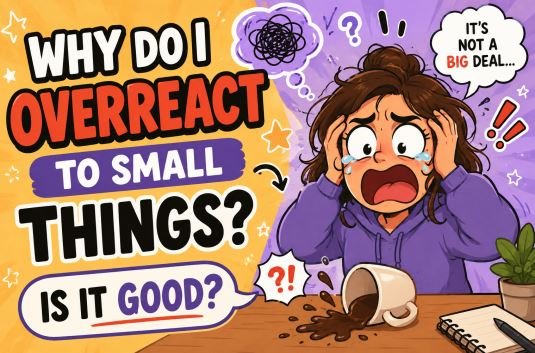
I don’t want to overreact, but even small things hurt me badly. Yes, I know it is not good, so I want to overcome this habit.
Because of my overreacting behaviour, I have lost a genuine friend, and I always have disputes with my family, partner, and colleagues.
My heart is pure; I have no inner anger for anybody. But my mouth is bad; I lose my temper over small things.
Nobody trusts me. Nobody wants my company. I feel bad.
It has become my habit. I hate me.
Most of the time, my mood is off, and I feel unhappy, stressed, tired and lost.
What are the reasons, and how can you solve this psychological problem? Let’s discuss through this article.
Reasons you overreact to small things
1. You are not allowed to speak frankly
A strict environment can cause this issue. If you become short-tempered and overreact to simple matters, then you are living in such an environment where you are not allowed to raise your voice.
For example, strict parents, teachers, or even a reserved society give birth to such children.
One man said, I have one problem, and if I share that problem with my parents, I get 10 more problems.
When you feel guilty after you share your problems. Or you get directly punished instead of being heard. Then you start to become a sensitive and overreacting person.
When you are continuously neglected and unheard by people you trust, then those untold words convert into anger.
It is not my problem, solve yourself; I don’t care; how dare you speak like that; please don’t come to me with problems. If you frequently hear these statements from near and dears, slowly you become quiet and short-tempered.
2. You have a controlling nature.
Some people want to control others and use their reactions to do so.
Just think for a while;
Do you react only to your juniors and your rank people, or also to your superiors?
If you show harsh reactions only to your parents, spouse, partner, and some friends, then it means you want to control them.
You may not do so with the intention of hurting them or bringing them down. But one thing is clear: you want domination over them.
This happens when you have external unsolved and unheard matters.
For example, your boss taunted you today. You don’t dare to reply to your boss, and you may bring those emotions home and react. You become angry in small matters, not because you are angry with them, but your anger gives you peace for a while. Also, you know they are your own people, and they will not leave you anyway; however, you respond.
It is completely the wrong way to clear emotions and solve problems. Your relationship may affect you in the long run.
3. You have a habit of relating everything to past events.
Most of the jokes relate to our lives. Some people have a high sense of humor. They take the joke as a joke and don’t try to understand its depth. While other people take jokes personally.
Yes, you may have gone through many ups and downs in life, may have experienced depression, or even survived bad events. Whatever. But every person has their own way of communication.
But you failed to understand this and think that they are targeting you. This insecurity forces you to overreact to small things and hampers your relationship.
Most of the time, overthinkers do this. Although their physical body is there, their mind is busy thinking about something else. And in the meantime, if they hear something sensitive, they respond quickly, without understanding the matter.
4. You keep expecting too much from them.
I have observed that those who are highly dependent on others show overreaction to small things.
Another thing is that. Some people are practical in that they clearly state the expectation to be fulfilled.
But some people think that their partner should know what is running in their head and fulfill it without demanding. This usually happens in a toxic relationship, and that dependent partner becomes extremely overreactive.
Dependency increases expectations. When expectations are not fulfilled, the person starts to overreact to minor issues.
5. You want to say you are not how they think.
When you are already tired of overexplaning, you don’t want to waste your energy anymore. But, again, the same question arises; instead of a calm response, you overreact with harsh words over small things.
The same thing happens in the family. If you are misunderstood, untrusted, and neglected all the time, you will become arrogant and egoistic. Arrogance and ego exaggerate the situation.
In reality, your reaction is not anger, but it sounds something like this: “I am tired. I don’t want to prove anything further.” “There is no point being nice with you.” It means you are seeking validation in different way.
6. You are still immature.
The mature person knows that networking skills can build a legacy. They invest most of their energy in connecting with worthy people. So, they have a good relationship with the boss because they know the boss is a promoter; they have a good relationship with their spouse and parents because they are their true people; they have a good relationship with friends because they know they are their second parents; they have a good relationship with strangers, because they don’t want to have enmity with anyone.
But what immature people do? They show their anger. They overreact to fulfill their ego.
Why will they tolerate their anger and overreaction? Are you a king?
You are still mature…Sorry, I am not hurting you, but it is true.
Focus on building relationships.
How to stop overreacting to small things?
Here are some things you need to consider if you lose your temper and overreact to everything:
1. To whom are you reacting?
Who is that person with whom you often overreact? Do you show the same behaviour with everyone? Do you show overreaction only with known people? Are you reacting to a scholar or a dumb person? Does he respond to you accordingly or tolerate your behaviour?
Whoever that person is, you are slowly destroying your relationship.
I would say don’t respond to the scholar because, whatever he may be true, learn to accept it.
If you are reacting to dumbs, you are the dumbest. It is like throwing a stone in the mud. You may have long-term enmity with him.
There is no point showing aggressive behaviour to near and dears because they are the people who will stand with you in your hard times.
Overall, if you learn the value of building relationships, you may stop being rude in small matters.
2. On what matters do you react?
Brother, please bring me a glass of water!
Bring yourself, I am busy.
How dare you not follow my instructions?
Don’t you listen? Am I busy?
Then the peaceful environment gets heated.
Don’t you think these kinds of issues are normal, which can be solved with understanding rather than being harsh?
Yes, most of the time this happens in relationships. That is just an example.
Sometimes you overreact, not because it is compulsory, but to win, to satisfy your ego.
In return, what do you lose? Peace. Yes, you lose peace.
Losing peace makes you unproductive, mentally weak, and self-doubting.
If you are ready to disturb the peace of all parties in a small matter, you are not a wise person. You are not a wise person who can hurt others just to fulfill your ego.
The heart is won by 2 sweet words, not 1000 bad reactions.
3. Avoid such a circle
The habit of making a mountain out of a molehill is like a communicable disease. It doesn’t transfer from person to person but from place to place.
For example, if you frequently blow things out of proportion in your love relationship, sooner or later, you will start to do the same in your friend circle as well. Because your emotional needs and expectations are not fulfilled. You are still mentally unstable.
Therefore, try to cut off ties with toxic relationships, friendships, and even the home environment.
You can accept 10 taunts from someone, but not forever; it creates frustration. Avoid such a circle where you are devalued. Otherwise, overcorrecting will become your permanent habit.
4. Avoid self-doubt and build up confidence.
Sometimes, being low on confidence and self-doubt can make you a reactive person. During these situations, you feel unworthy, low-esteemed, and shy. So, to avoid emotional hurt, you may overuse words repeatedly.
During the phase of self-doubt, you already feel hurt and seek emotional assistance. But instead of getting motivation, if you get thorny replies, you may respond more harshly.
Therefore, the only solution is to build up self-confidence. Confident people are less likely to react in every situation. They are more secure and weightful.
5. Clearly tell your expectations
I love you
I love you too.
No, you don’t love me, you just pretend to love me.
I love you, anything else.
No. You don’t.
This is one of the most embarrassing moments in a marriage or a relationship. A couple wants something that gives them security, but doesn’t expose them openly. They think he/she must know if he really loves me. Then, after a few days, this creates ignorance and negligence, and overreaction starts. Sounds funny, but it is true.
Look, brother and sisters, nobody has a superpower to understand your heart and mind. It is your responsibility to express your expectations genuinely.
You can tell why you are upset. Why are you doubting? Why are you silent?
If the problem is known, there is an easy solution.
But no.
There will be drama, and the situation will become toxic over time.
So, most of the time, try to apply a practical approach in your life and communicate openly without fear.
Don’t fear before you express. And sometimes, accept the rejections.
6. Learn Skills
A skilled person has the power to earn whatever he wants. No need to depend upon anyone, no expectations, and no stress.
You may see skilled people are not that reactive. They have inner pride and neglect minor issues. They have confidence.
I want to say learn valuable skills such as emotional intelligence, communication, diplomacy, or other technical skills that will make you an independent person.
In conclusion
Sometimes you may also react disproportionately to protect your genuine feelings. When true feelings are rapidly ignored and mocked, you start showing this behaviour.
Anyway, I want to say, it is completely bad to overreact to small things. If you can’t tolerate simple situations, what will you do if all the responsibilities hit you at once?
Also, not reacting in every situation is an act of self-protection. It gives you peace and security.
“Worst situations are like a storm. You can’t stop the storm. But you can stay somewhere quietly until the storm stops.” Apply the same formula here also.
Take Care 🙂